Your Home Is Either Working For You or Against You
Your home is either working for you — or working against you.
There is no middle ground.
Every time you walk into a room, the environment is doing something to your behaviour. It's pulling you toward the next task or away from it. Making things easier or harder. Adding to your mental load or reducing it.
Most people never think about this. They attribute their behaviour — their energy, their patience, their follow-through — to character. To effort. To how disciplined they are that particular day.
But the environment shapes behaviour before the person does. And once you understand that, the question stops being 'why can't I keep this up?' and starts being 'what is my environment asking of me?'
What clutter actually costs
Princeton researchers found that visual clutter competes directly for your attention — even when you're not actively looking at it. Your brain is constantly scanning the environment, and disorder forces it to keep processing, keep registering, keep working.
That work is invisible. It doesn't feel like effort. But it accumulates — and by mid-morning, it's already cost you something you didn't plan to spend.
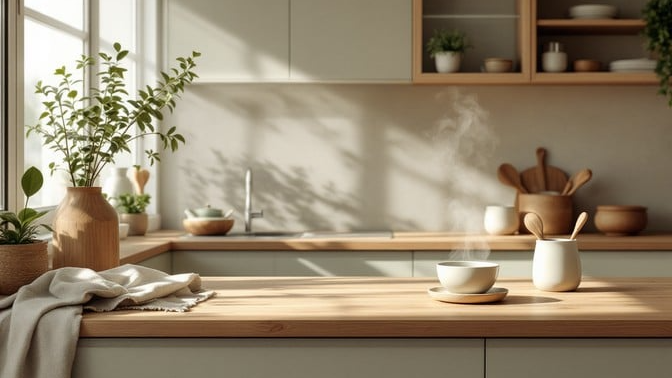
A cluttered kitchen surface at 7am isn't just an aesthetic problem. It's a cognitive one. Your brain registers every unresolved thing in that space before you've had your first coffee.
A clear surface means a clear start. Nothing to manage. Nothing competing for your attention. Just the morning.
The three zones that control your day
You don't need to reorganise your entire home. You need to stabilise the three zones that have the highest impact on how your day begins and ends.
The kitchen surface controls the tone of your morning and your evening. A reset kitchen the night before means tomorrow starts clean. A cluttered one means tomorrow starts in debt.
The entry zone controls the friction of leaving and returning. Keys, bags, shoes, chargers — if any of these don't have a permanent, obvious home, you're paying for it every single morning. The exit should be something you don't have to think about.
The bedroom is your recovery zone. Visual clutter in the bedroom follows you into sleep and out of it. Clear surfaces signal to your nervous system that the day is done. A visually busy bedroom keeps it slightly on alert — all night.
These three zones don't solve everything. But they control the entry and exit points of your day. When they're stable, the whole day runs differently.
Designing instead of managing
The difference between a home that works for you and one that works against you isn't the size of the house or how much stuff you own. It's whether the environment has been intentionally designed to support what actually happens there.
An entry zone with a hook for keys, a shelf for bags, and a basket for chargers doesn't require discipline to maintain. It maintains itself — because the design makes the right behaviour the easiest behaviour.
A kitchen surface with a defined reset standard doesn't require motivation. Once the standard exists, it takes less effort to meet it than to work around it.
That's what it means for your home to work for you. Not a perfect home. A designed one.
Where to start
Pick one zone this week. Not all three — just one.
Decide what 'reset' looks like for that zone. Write it down. Do it tonight. Then do it again tomorrow night.
By the end of the week you'll have built the habit of it — and you'll feel the difference in how that part of your day runs.
The free Home Reset Guide
The free Home Reset Guide walks you through all three zones — with a simple exercise for each one that you can do in an evening.