Why Your Home Drains Your Energy (And How to Fix It)
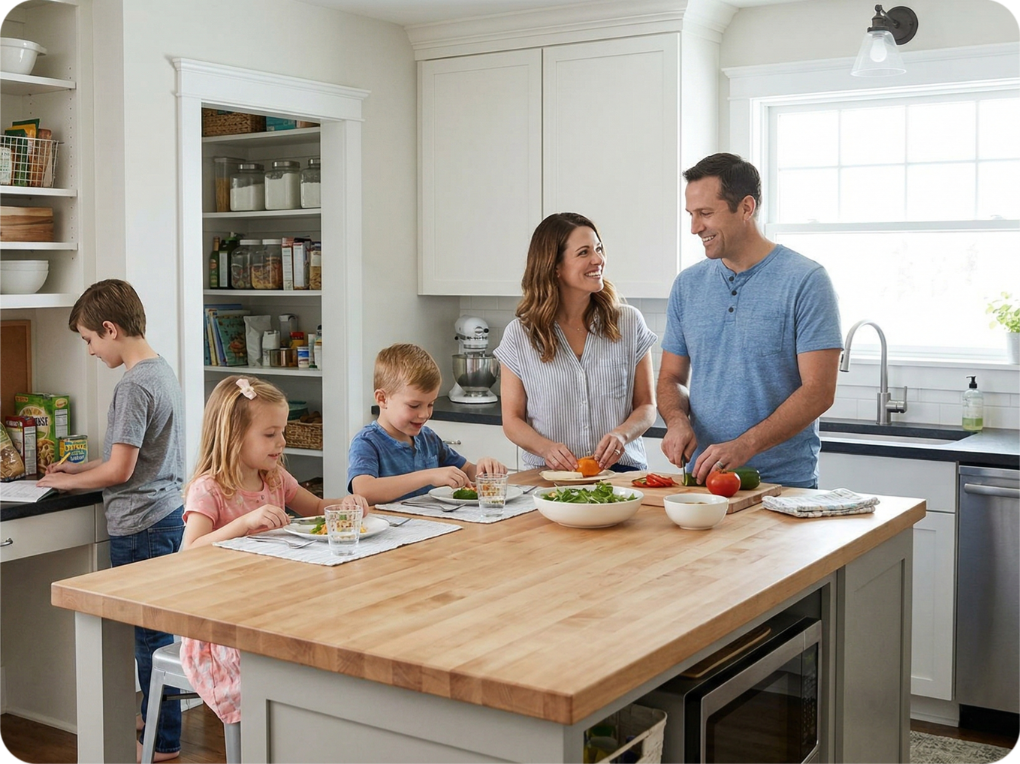
What Is a Calm Home System?
A Calm Home System is a structured way of organizing your home so that it supports your energy, reduces stress, and makes daily life easier.
It’s not about perfection, minimalism, or constant cleaning.
It’s about creating an environment where:
- You know where things are
- Daily routines feel natural
- Your home supports your focus instead of draining it
Most people try to organize their home piece by piece.
But without a system, it never holds.
The Calm Home System fixes that.
INTRODUCTION
In our modern pursuit of productivity, we are obsessed with the "inner work." We buy planners, download habit-tracking apps, meditate to increase our focus, and read countless books on self-discipline. We treat our minds like the engine of a car, constantly trying to tune it for better performance.
But we often ignore the road that car is driving on.
If you try to drive a Ferrari on a mud-slicked, boulder-strewn path, it doesn’t matter how powerful the engine is—you’re going to struggle. For most of us, our home is that mud-slicked path. We try to be "high-performance" individuals while living in environments that are architected for friction, distraction, and exhaustion.
Your home is not just a place where you sleep and keep your stuff. It is the invisible architecture of your behavior. If you want to fundamentally change your life, you have to stop trying to "try harder" and start designing a system that makes success inevitable. This is the Calm Home System.
Table of Contents
- Why Your Home Is More Important Than You Think
- The Hidden Problem: Environmental Exhaustion
- Friction vs. Flow (The Core Principle)
- The 4 Layers of a Calm Home
- Practical Implementation: Room by Room
- The Maintenance System
- Why This Changes Everything
Why Your Home Is More Important Than You Think
Most people view their home through the lens of aesthetics or comfort. We ask, "Does this couch look good?" or "Is this bed soft?" While those things matter, they miss the functional reality: Your environment is a physical manifestation of your mental state, and conversely, it dictates your mental state.
The Biology of Space
Our brains are remarkably sensitive to environmental cues. Evolutionary psychology tells us that humans are constantly scanning their surroundings for threats or opportunities. In a modern context, "threats" aren't saber-toothed tigers; they are piles of mail, unwashed dishes, and misplaced keys.
Every unfinished task in your line of sight represents an "open loop." According to the Zeigarnik Effect, our brains remember uncompleted tasks more vividly than completed ones. When you sit in a cluttered living room, your brain is running a background script of everything you haven't done. This leads to a state of chronic, low-level cortisol production. You aren't "relaxing" on that couch; you are physiologically managing stress.
The Myth of Discipline
We place a massive burden on discipline. We blame ourselves for not having the "willpower" to eat healthy or work out. But discipline is a finite resource.
If your kitchen is organized so that a bag of chips is the first thing you see, and the salad spinner is buried behind five heavy pots, you aren't "lazy" for choosing the chips—you are responding to the path of least resistance. The Calm Home System isn't about becoming a more disciplined person; it’s about making discipline unnecessary by engineering your environment to support your goals.
The Hidden Problem: Environmental Exhaustion
You don’t feel tired because you’re inherently low-energy. You feel tired because your environment is an "energy vampire."
Decision Fatigue
Every time you have to decide where an object belongs, or search for a tool you need, you consume a unit of mental energy. By the time most people leave their house in the morning, they have already made dozens of micro-decisions:
- Where are my keys?
- Is this shirt clean or dirty?
- What should I do with this piece of mail?
- Where is the charger?
This is Decision Fatigue. By the time you sit down to do your most important work, your "decision battery" is already at 40%.
Reaction vs. Action
A chaotic home forces you into a Reactive State. You react to the mess, you react to the missing items, and you react to the feeling of being overwhelmed. When you are reactive, you cannot be intentional. You spend your day "putting out fires" in your own living room rather than moving toward your long-term vision.
Friction vs. Flow (The Core Principle)
The Calm Home System is built on a single, binary principle: Everything in your home either creates Friction or facilitates Flow.
🔴 Friction: The Invisible Brake
Friction is anything that makes a desired action harder.
- Physical Friction: A heavy vacuum cleaner that is hard to pull out of the closet.
- Visual Friction: A desk covered in random papers.
- Cognitive Friction: Not knowing where your tax documents are kept.
Friction causes procrastination. If a task feels "heavy" before you even start it, you will find a reason to check your phone instead.
🟢 Flow: The Natural Momentum
Flow is the state where the environment pulls you toward the right action.
- The Coffee Flow: Everything you need for your morning coffee is located in a single 2-foot radius. You can make it while half-asleep because the system is intuitive.
- The Workout Flow: Your gym clothes are laid out, and your water bottle is filled the night before.
The goal of the Calm Home System is to aggressively eliminate friction and ruthlessly optimize for flow.
The 4 Layers of a Calm Home
To transform a house into a Calm Home System, you must work through these four layers in order.
Layer 1: Clarity (Defining the "Why")
Clarity is about the purpose of space. Most homes suffer from "Spatial Ambiguity." The kitchen counter becomes a workspace, the bedroom becomes a theater, and the dining room becomes a storage unit.
When a space has mixed signals, your brain doesn't know which "mode" to enter.
- Action: Assign a singular, non-negotiable purpose to every major surface and room. If the desk is for deep work, no food or mail is allowed on it. If the bedroom is for sleep, no laptops are allowed.
- The Result: Your brain develops a "Pavlovian" response to your rooms. You sit at your desk, and your brain automatically clicks into "Work Mode."
Layer 2: Accessibility (The Proximity Rule)
The things you use daily should be the easiest to reach. This sounds obvious, but look at your cabinets. Are your daily vitamins behind the holiday-themed platters you use once a year?
- The 1-Motion Rule: For your most frequent tasks, try to make the necessary tools accessible in one motion. Open a drawer—there it is. No digging, no moving other things.
- Reverse Accessibility: Make bad habits harder to access. Put the TV remote in a drawer in another room. Put the junk food on the highest shelf. Use friction as a tool for good.
Layer 3: Simplicity (The Cognitive Load)
Simplicity is the process of reducing the number of "nodes" your brain has to track. Every object you own is a commitment. You have to clean it, store it, maintain it, and think about it.
- Inventory Reduction: Most of us are living with 30% more "stuff" than our current systems can handle. When your "stuff" exceeds your "system," you get clutter.
- The "One-In, One-Out" Rule: To maintain simplicity, never add an item to your home without removing one. This forces you to evaluate the true value of every purchase.
Layer 4: Flow (The Sequence of Life)
Flow is about the movement through your home. It’s the "user experience" (UX) of your life.
- The Launchpad: A dedicated area by the door for everything you need to leave the house (keys, wallet, bag, umbrella). This ensures your day starts with flow, not a frantic search.
- The Reset Routine: A system for returning the home to its "baseline" state every evening. This isn't "cleaning"; it's "re-priming" the system for the next day.
The Practical Implementation: Room by Room
To turn this philosophy into reality, let’s look at how the Calm Home System applies to specific areas.
The Entryway (The Buffer Zone)
The entryway is the most important part of the house for your mental health. It is the transition point between the chaos of the world and the sanctuary of your home.
- The System: Install hooks for bags, a bowl for keys, and a dedicated spot for shoes.
- The Rule: Nothing "lives" here that doesn't belong to the transition of coming or going. No "to-be-sorted" piles.
The Kitchen (The Fuel Station)
A kitchen with friction leads to poor health. If cooking feels like a chore because the counters are cluttered, you will order takeout.
- The System: Clear the counters of everything except the 3 items you use every single day. Use "zone-based" storage: a baking zone, a coffee zone, a cleaning zone.
- The Flow: Organize the fridge so that healthy, prepped food is at eye level.
The Workspace (The Focus Lab)
If you work from home, your environment is either your greatest collaborator or your loudest distractor.
- The System: Eliminate all visual noise. Use cable management to hide "tech-tangle." Ensure your lighting supports focus (cool light for work, warm light for evening).
- The Flow: At the end of the work session, clear the desk completely. This signals to your brain that the "Work" program has been closed.
The Bedroom (The Recovery Suite)
The bedroom should be a sensory deprivation tank for stress.
- The System: Remove all electronics. Use "closed storage" (drawers and closets) so you don't see your clothes while you're trying to sleep.
- The Flow: The only thing you should be able to do in bed is sleep or read. This strengthens the mental association between the bed and rest.
Why This Changes Everything: The Compound Effect
When you implement the Calm Home System, you aren't just tidying up. You are reclaiming Mental Bandwidth.
Imagine you save just 15 minutes a day by not looking for items, and you save 10 units of "willpower" by not having to fight your environment.
- In a week: That’s nearly 2 hours of reclaimed time and a massive surplus of mental energy.
- In a year: That’s 100 hours of time and the emotional capacity to take on a major life goal, start a business, or deepen your relationships.
The Calm Home System creates a positive feedback loop. A calm home leads to a calm mind. A calm mind makes better decisions. Better decisions lead to a better life.
The Missing Piece: The Maintenance System
Most people fail because they treat organization as an "event." They spend a weekend cleaning, and two weeks later, the house is a wreck again.
The Calm Home System is not an event; it is a Process.
- The Daily Reset: A 10-minute "sweep" before bed to put things back in their designated homes.
- The Weekly Audit: A 30-minute check to see where friction is building up. Did a "junk drawer" start forming? Is the "Launchpad" getting messy?
- The Quarterly Purge: A seasonal review to remove items that no longer serve the system.
You don't need a "perfect" home. You need a resilient home. A system that can handle the mess of daily life and be restored to "flow" in under 15 minutes.
Final Thought: Your Environment is Your Destiny
We like to think we are the masters of our fate, but for the most part, we are the products of our surroundings. If you are surrounded by chaos, your thoughts will be chaotic. If you are surrounded by friction, your progress will be slow.
You have the power to design the world you live in. You can build a home that drains you, or you can build a Calm Home System that fuels you.
Stop trying to change your habits. Start changing the environment that creates them.
Frequently Asked Questions
What is the best way to organize your home?
The best way to organize your home is to create a system — not just clean or declutter. Start by defining the purpose of each space, reduce unnecessary items, and make frequently used things easy to access. A well-organized home should support your daily routines automatically, not require constant effort.
How do I keep my home organized long-term?
To stay organized long-term, you need a maintenance system. Use a simple structure:
- Daily reset (5–10 minutes)
- Weekly reset (30–60 minutes)
- Seasonal or quarterly decluttering
Organization is not a one-time project — it’s a process that keeps your home functional over time.
Why does clutter make me feel stressed?
Clutter creates mental overload. Every visible item competes for your attention and signals unfinished tasks to your brain. This increases decision fatigue and low-level stress, even if you’re not aware of it. A structured environment reduces this mental noise and helps you feel calmer and more in control.
What is a home organization system?
A home organization system is a structured way of designing your environment so it supports your daily life. Instead of constantly deciding where things go, the system makes actions automatic. It reduces friction, saves energy, and helps you stay consistent without relying on motivation.
How can I organize my home when I feel overwhelmed?
Start small. Focus on one space, one drawer, or one surface. Don’t try to fix everything at once. The goal is to build momentum. As you reduce clutter and create simple systems, your energy will increase and the process becomes easier.
What is the difference between decluttering and organizing?
Decluttering is removing things you don’t need. Organizing is deciding where things should go. You need both — but organizing without decluttering usually fails because there is simply too much to manage.
How long does it take to organize a home?
It depends on the size of your home and how much you own. But more importantly, organization is not a one-time task. You can create a functional system in a few days, but maintaining it is an ongoing process through small daily and weekly habits.
Can a clean home really improve productivity and focus?
Yes. Your environment directly affects your ability to focus. A cluttered space increases distractions and decision fatigue, while a structured space makes it easier to start and continue tasks. Many people notice improved focus and energy simply by organizing their surroundings.
Where should I start when organizing my home?
Start with high-impact areas:
- Entryway (daily transitions)
- Kitchen (daily habits)
- Workspace (focus and productivity)
These areas influence your day the most and give quick results.
Do I need to be a minimalist to have an organized home?
No. You don’t need to be a minimalist. The goal is not to own as little as possible — it’s to own what your system can handle. A well-designed system works whether you own a little or a lot, as long as everything has a clear place and purpose.
Ready to Build Your Full System?
This post is the foundation, but there is a deeper architecture to building a high-performance life. If you want to move beyond just "organizing" and start "optimizing" every facet of your daily existence—from your digital workflow to your physical vitality—we have a complete roadmap for you.
This guide shows you exactly how to build a calm, structured home — step by step.
Download the free guide to create a calm, structured home — step by step.